American Women, World War I, and World War II DBQ
-
Write a 4 paragraph essay...Thesis, 2 supporting arguments, and a conclusion. Each argument should be supported by outside evidence and 3 documents. Two of those documents need to be analyzed ....title, audience OR purpose OR perspective, and some outside evidence that supports the document. Mention 2 more documents...1 for each question.
Evaluate the extent of difference between American women’s experiences in the First World War (1914–1918) and in the Second World War (1939–1945).
-
1) _____Write the Question 3pts
a) _____Name 3pts
b) _____Date 3pts
c) _____Grammar 3pts
d) _____2 Pages 3pts
2) _____ Thesis – 1st paragraph 3pts
a) _____ Supporting Argument #1 3pts
b) _____ Supporting Argument #2 3pts
3) _____Supporting Argument #1 – 2nd paragraph 3pts
a) _____ Background – discuss historical period documents and/or question is from. 3pts
b) _____Names OR Events OR Vocabulary AND why they are important. 3pts
c) _____Names OR Events OR Vocabulary AND why they are important. 3pts
d) _____Names OR Events OR Vocabulary AND why they are important. 3pts
e) _____ Document analysis – author’s purpose, point of view, or audience & quote. 3pts
f) _____ Document analysis – author’s purpose, point of view, or audience & quote. 3pts
g) _____ Document analysis – Discuss. 3pts
h) _____ Historical Accuracy (are the historical facts correct) 3pts
i) _____The Argument answers the question3pts3pts
4) _____ Supporting Argument #2 – 3rd paragraph 3pts
a) _____ Background – discuss historical period documents and/or question is from. 3pts
b) _____Names OR Events OR Vocabulary AND why they are important. 3pts
c) _____Names OR Events OR Vocabulary AND why they are important. 3pts
d) _____Names OR Events OR Vocabulary AND why they are important. 3pts
e) _____ Document analysis – author’s purpose, point of view, or audience & quote. 3pts
f) _____ Document analysis – author’s purpose, point of view, or audience & quote. 3pts
g) _____ Document analysis – Discuss. 3pts
h) _____Historical Accuracy (are the historical facts correct) 3pts
i) _____The Argument answers the question 3pts
5) _____ Contextualization (summarize the time period) – 4th paragraph 3pts
a) _____ What was occurring? 3pts
b) _____ Where were the event occurring at? 3pts
c) _____ Why were these events occurring? 3pts
d) _____ How were these events occurring? 3pts
e) _____ Who was involved and in what ways? 3pts
-
Date of writing: 2/15/2026
Time limit: 50 minutes
Preparation time: 4 days
Word count: 1000
Grade: 94%
While it's arguable that the magnitudes to which American women's experiences in the First World War differed from the Second World War are similar, the way in which they differed varied significantly. The experiences of American women in World War I were largely characterized by political and social shifts, moving women into more powerful societal positions they were previously not present in. However, World War II was primarily marked by a significant change in economic and military opportunites available to women.
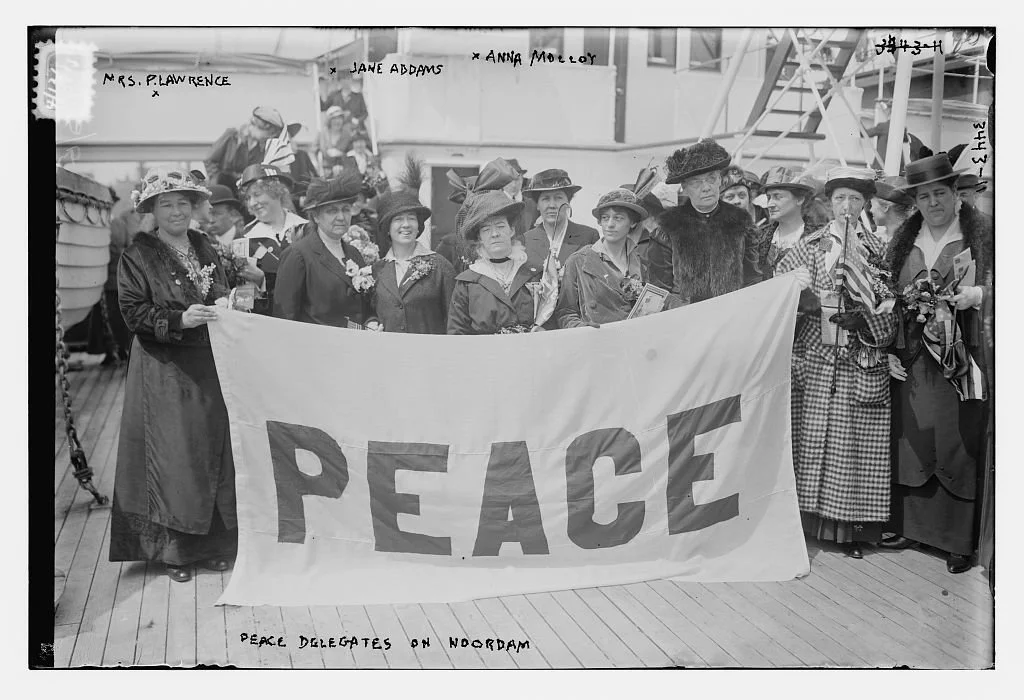
To understand the extent to which women experiences were changed between the two World Wars, it must be noted that during World War I---due to large amounts of men being drafted into the military---there were labor shortages in industrial jobs that would otherwise be filled with men, allowing for women to participate in the industrial workforce. With such a major societal shift in traditional women roles, it's no surprise that women began asserting political voices. This is best exemplified by the Women's Peace Party, an organization that platformed feminist figures and advocated for immediate global mediation against the war. The idea that the Women's Peace Party spoke out against the war is also represented in Document 1, in which Jane Addams states, "I am speaking for those women all over the country who cannot understand why the Government should want to 'prepare' before there is need to contemplate any war," pushing for disarmament. Additionally, women's roles changed not only politically, but socially too. Through the establishment of the Women in Industry Service, a temporary agency that established policies and standards for female workers, the government actively and indirectly defined women as necessary to the nation in terms of industrial output. Document 2 corroborates this perspective, displaying a poster that blatantly highlights women as a powerful workforce that could contribute greatly to the United State's World War I efforts. Similarly, the war not only expanded women presence in the industrial workforce, but it also accelerated women suffrage. Document 3 perfectly demonstrates this, recalling Woodrow Wilson's address to the Senate on women suffrage, in which he states, "we have made partners of the women in this war; shall we admit them only to a partnership of suffering and sacrifice and toil and not to a partnership of privilege and right?" Wilson's address not only advocates for the women political participation, but it could also be viewed as a subtly empowering statement that politically backed women across the nation---a backing that would soon pay off with the passing of the Nineteenth Amendment in 1919, following World War I. In its entirety, the First World War was largely shadowed by the major political and social shifts of women into larger, vocal, and more influential positions.
While World War I outlined the introduction of women into more political and socially powerful roles within American society, World War II primarily highlighted economic and military-related shifts in those roles. For background information, the domestic roles of women within the United States also began changing, as with more job opportunities, it was significantly easier for women to become breadwinners. The momentum of the changing of traditional values carried not only into households, but also into factories. While the First World War pushed women into industry, the Second World War normalized their presence. This is best exemplified by the famous poster of "Rosie the Riveter," an illustration that promoted the participation of women in the workforce. Document 4 continues this idea, as through the eyes of Ruth Matthews and Betty Hannah, it can be interpreted that women were not only entering industrial jobs rapidly during wartime, but also establishing agendas---stating that good money comes from hard work. Likewise, women were also being institutionalized within Government spaces, most notably in the military. With the onset of the Second World War, the creation of WASPs, WAVES, and WACs acted as a primary entry point for women willing to contribute to the war effort. Document 5 illustrates the societal shift of women into the military during World War II by showing a poster of the Marine Corps Women's Reserve. Although, it should be noted that aside from military participation, the war also aided the more marginalized women population---African American women---in a more economic way. With the influx of women entering the workforce, the enacting of Executive Order 8802---a government action that prohibited discrimination in the defense industry and federal government---was a final push for women rights and female presence within American society. The photograph displayed in Document 6 is a buttress for this perspective, conveying the significance of African American women in industrial jobs to the overall rise of the mobilizing wartime femal workforce. Holistically, the Second World War symbolized an economic opening and a military entry point for women across the United States.
The stated events, such as the establishment of the Women Peace Party, the distribution of "Rosie the Riveter," and the passing of Executive Order 8802, all occured across the span the First and Second World Wars. While the majority of these events took place in local communities, distant factories, and federal workspaces all around the United States, their implications were most definitely global, mobilizing feminist movements beyond America. This shifting of traditional women roles can mainly be attributed to the imposing---but ephemeral---wartime environment, which sparked women leadership in places lacking male presence and engendered female persistence where male influences were absent. Due to this, the culmination of feminist mobilization ultimately unfolded in growing political influence, altering domestic perspectives, and redefining of traditional values. The most notable figures present in such a shift were Jane Addams---the president of the Women's Peace Party---and Woodrow Wilson---the President of the United States during First World War. Even if the two World Wars did not properly grant the rights women were fighting for during the time period, it undoubtedly changed the significance of women across the world.