Light Pollution
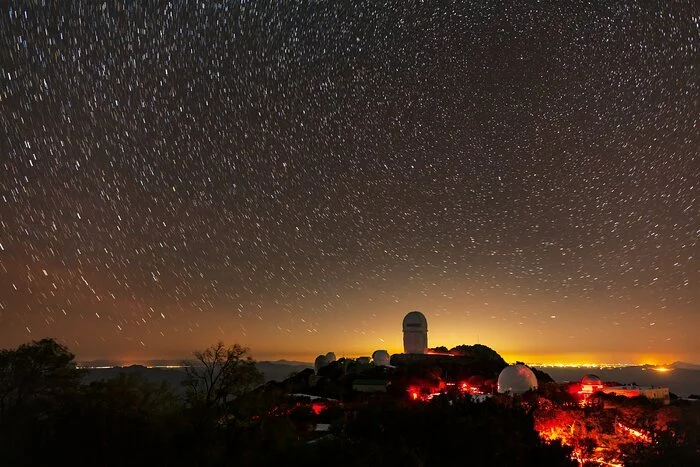
Credit: KPNO/NOIRLab/NSF/AURA/B. Tafreshi, https://noirlab.edu/public/images/IMG_2222-CC
The Tucson sky really is a wonder. It’s also a punishment.
Most don’t see the full sky due to light pollution and other causes that may obstruct your view of the starry night. If you were to travel a few miles towards the Catalina mountains, suddenly the light coming from the center of Tucson begins to fade. This is almost like an illusion, where your view gets better the further you are from light. This illusion is because when large amounts of light radiate, they kind of clump, becoming a huge ‘flashlight’. The light, illuminating from the cluster, distorts colors of the night sky; resulting in the bright yellow glow we can see in larger cities.
This bright yellow glow can be a hassle for night time photographers or stargazers. This glow spreads far out, even to the mountains.
So if you love the night sky, and don’t want it to fade before dawn, heed my advice. If you travel to see the stars, I don’t recommend traveling into the mountains. This is because, if you are in the mountains during the pitch baclk night to stargaze, sure it’s a view, but a trouble to descend back down; even trouble going up!
Another piece of advice to stargazing is: Always bring a flashlight and always have a map. If you want to make it back home from your long night of stargazing or something, it’s really important to know where to go.
Anyway, I am here to tell you of my nights spent stargazing in Tucson and the wonders I saw living so far from the glowing downtown.
One of my favorite times to stargaze is in the winter. As uncomfortable as it is to sit outside in freezing weather, the sky will only make it better. In the winter, nights become long and darker. This allows for quality stargazing time. In the winter, nights in the mountains droop down to an astonishingly low light level. And what’s even better is that since lights slowly turn off as midnight approaches (especially seeing as some people just want to snuggle, warm in their blankets during winter), the light pollution decreases a large amount.
Taking advantage of the cold winter nights has allowed me to witness things no camera can catch. Such as the sight of a: satellite solar panel reflection (SSPR but can also be referred to as a ‘satellite flare’). SSPR is rare, and happens usually when a satellite's SP (solar panels) are turned to a perfect degree. This creates a bright yellow-orange reflection for a moment in time when it reflects sun off of its panels. The reason SSPR is rare is because of the timing needed for this to happen. The sun needs to be slightly in the sky to a point where it doesn’t overshine everything, and a satellite with a perfectly angled solar panel needs to be floating into veiw. SSPR will cause a bright orange-yellow flash in the sky for a very brief moment (almost 1.5 - 4.0 seconds). Just keep in mind, a solar panel can come in many different colors.
Another wonder that I saw in my time stargazing in Tucson, are the many seasonal meteor showers that you can watch as they rain down in the sky. These meteor showers can shine meteorites of many different, multi-colored meteors.